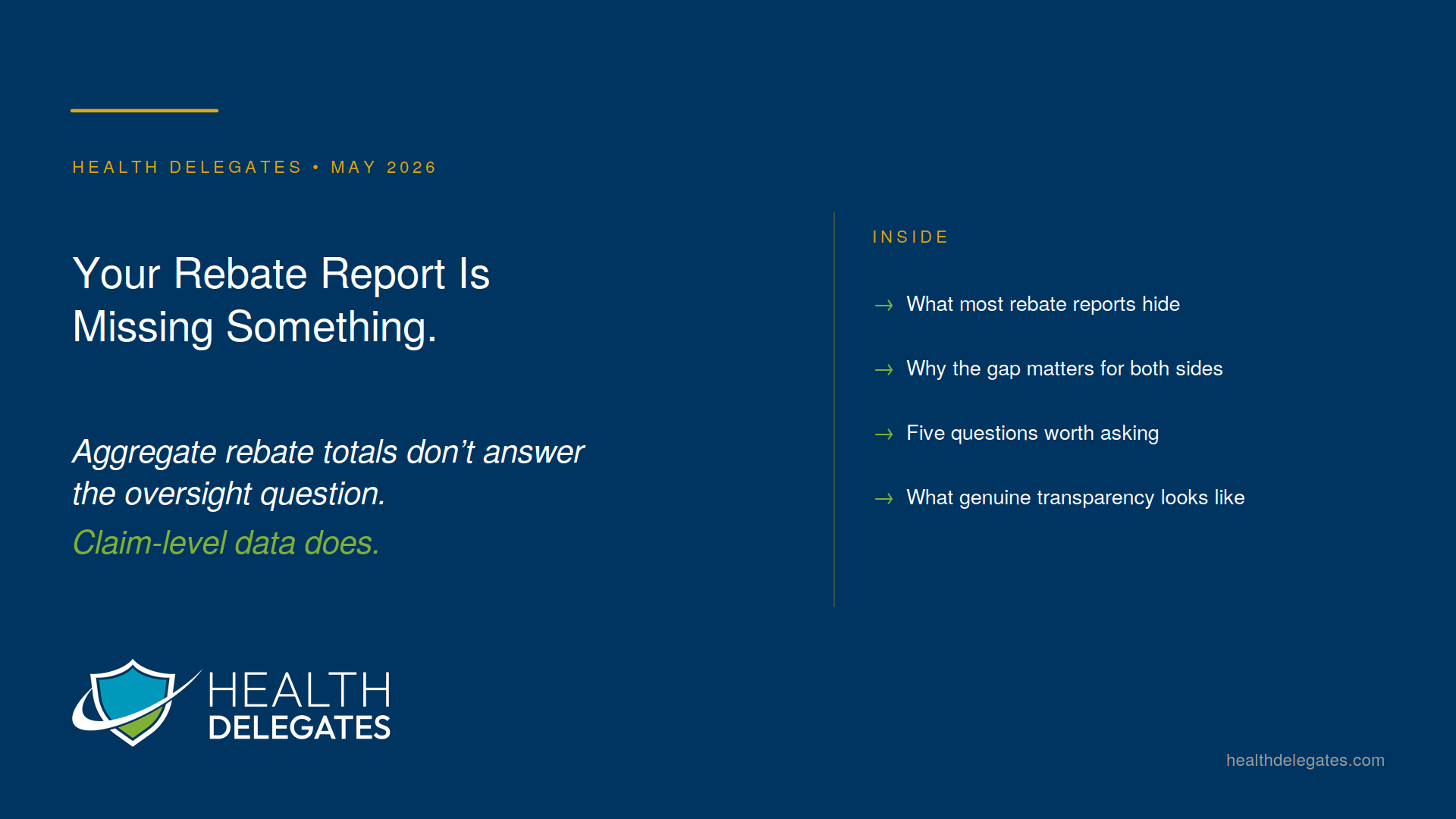
Your Rebate Report Is Missing Something
Here’s What Both Sides of the Table Should Be Asking For
Pharmacy rebate reporting is under pressure. Employers are being held to higher fiduciary standards than ever before. PBMs are being asked by those same employers — and by regulators — to show their work at a level of detail that used to sit behind contractual confidentiality. And the market is shifting toward transparency faster than most reporting infrastructure was built to handle.
For any organization responsible for pharmacy spend — whether you’re an employer plan sponsor evaluating your benefit, or a PBM reporting results to your clients — the question isn’t whether claim-level rebate visibility becomes the standard. It’s how quickly you’re ready to provide it or require it.
What Most Rebate Reports Actually Show
A typical quarterly rebate report shows aggregate data: total rebates collected, sometimes broken down by therapeutic category or by brand versus generic, often compared to a contractual guarantee.
What most reports don’t show: which specific drugs generated those rebates, how the rebate value compares to the net cost of clinically equivalent alternatives, and how formulary placement decisions weighed rebate contribution against clinical evidence.
That level of detail isn’t withheld for bad reasons. Historically, the infrastructure to report at the claim and NDC level across every manufacturer contract simply didn’t exist at scale. Reporting caught up to what was possible, not to what was ideal.
What’s changed is that the gap between possible and ideal is now the gap between standard practice and what clients are asking for.
Why the Gap Matters — for Both Audiences
For employer plan sponsors, fiduciary obligation under ERISA means prudently overseeing how plan assets are used. A wave of recent litigation — including class actions filed against Johnson & Johnson, Wells Fargo, and JPMorgan Chase — has centered on whether plan sponsors exercised sufficient oversight of pharmacy benefits. The specific allegations vary, but the common thread is the same: could the sponsor demonstrate, with data, that the pharmacy benefit was managed in members’ interests? Aggregate rebate totals don’t answer that question. Claim-level data does.
The Johnson & Johnson case was dismissed in late 2025, but the dismissal sharpens rather than softens the picture. The court reasoned that plan sponsors — not employees — are the parties best positioned to challenge PBM practices, because plan sponsors suffer direct financial harm and have the statutory and contractual rights to audit PBMs and access claim-level data. The responsibility for oversight is being pointed squarely at plan sponsors, and the data infrastructure to meet that responsibility is now the dividing line between defensible oversight and exposure.
For PBMs, the same shift is creating a competitive dynamic. Employer clients — and their consultants — are increasingly evaluating PBM partners on the depth of reporting available, not just on guaranteed rebate dollars. A PBM that can produce claim-level, NDC-level rebate transparency has a defensible answer to client due diligence questions. A PBM that can’t is competing on a basis that’s becoming less sufficient every renewal cycle.
The underlying point is the same on both sides of the table: the standard is moving, and the organizations ready to meet it are better positioned than those still reporting in aggregates.
Five Questions Worth Asking — No Matter Which Seat You’re In
These questions work whether you’re an employer evaluating your PBM, or a PBM pressure-testing your own reporting capabilities before a client asks.
- Is rebate data available at the claim and NDC level — not just by therapeutic class or in aggregate?
- For the top drugs by rebate dollar, what is the net cost after rebate, and how does that compare to clinically equivalent alternatives on the formulary?
- How does the formulary design process document clinical evidence independently of rebate value, so the two can be evaluated separately?
- What percentage of manufacturer rebates negotiated on the plan’s behalf is passed through, and is the methodology auditable?
- Do audit rights exist that let either party verify reported amounts against actual manufacturer contracts?
For employer sponsors, these are due diligence questions. For PBMs, they’re the same questions your largest clients are starting to ask — and being ready to answer them with data rather than narrative is a real competitive asset.
What Genuine Transparency Looks Like — and Who Delivers It
Claim-level rebate visibility, independent clinical decision-making, and auditable pass-through methodology aren’t a philosophical position. They’re operational capabilities, and they require infrastructure most organizations weren’t built to run internally.
That’s where Health Delegates sits. We’re a rebate solution provider and clinical management
organization that provides the infrastructure for transparency at the level the market is moving toward — serving both PBMs who want to offer this capability to their clients, and employer plan sponsors who need independent visibility into their pharmacy benefit.
For PBM partners, that means rebate solution infrastructure with claim-level reporting built in — a capability you can offer your clients without building it from scratch. For employer clients, it means an independent clinical and formulary management layer that sits alongside your PBM relationship, giving you the data and the oversight your fiduciary duty requires.
The standard is moving. We exist to help both sides move with it.
— Health Delegates
Subscribe for Exclusive Industry Insights
Contact Us